It is extremely important to protect the skin against the ultraviolet sunlight that climbers are exposed to while climbing Mt. Kilimanjaro.
Both too little and too much exposure to ultraviolet light is detrimental to the human being. On Mt. Kilimanjaro there is normally constant exposure to the sun and the higher you go up the mountain and above cloud cover, the more intense the exposure.
Exposure induces production of Vitamin D, which is associated with many health benefits including the maintenance of healthy bones, and regulation of the immune system. Too little exposure will cause Vitamin D deficiencies while too much exposure will produce sunburn, and even skin cancer.
Before I began climbing Mt. Kilimanjaro I assumed that sunburn does not affect dark skinned individuals. You learn fast on Mt. Kilimanjaro. Having not covered myself adequately during my first climb, I exposed both my face and ears for prolonged periods and a few days after the descent part of my skin on my face and ears (which are not that big and could have been easily covered by my balaclava) turned dark and became wrinkled and appeared to have encountered the temperatures of a barbecue fire.
The positive side when you forget to adequately cover yourself is that after several more days the affected skin dries and peels off and the new look makes one younger than his/her age, in my case ten years younger than I actually am. In addition to protecting the skin by clothing it is also important to apply sunscreen on the parts of the body that are exposed to sunlight, including the hands, arms, and back of the neck.

Sunday, 3 February 2013


Thursday, 10 January 2013
Keeping note on climbing Kilimanjaro
Climbing Mt. Kilimanjaro is such a unique experience that anyone who does so for the first time is likely to encounter a myriad of experiences from both the outstanding scenery and the challenge of the climb.
The best way to record these observations is to carry a small notebook or digital recorder to record these observations throughout the day. Most writers have lost excellent ideas or observations for failing to immediately record what is remembered.
The long treks from camp to camp do not only provide outstanding scenery, but they also tend to induce moments of reflection that cannot be found in other settings, in the office or at home. These moments are worth recording for anyone who is searching for a complete record of climbing Mt. Kilimanjaro.
I normally record the day's observations when I retire to my tent at the end of a day's trek. I have carried a digital recorder during a few of my climbs but at high altitudes and under extreme weather conditions the batteries of the recorder do not last for long.
Post related to this one:
http://blogkili.blogspot.com/2009/11/oops-i-may-have-lost-my-kilimanjaro.html
The best way to record these observations is to carry a small notebook or digital recorder to record these observations throughout the day. Most writers have lost excellent ideas or observations for failing to immediately record what is remembered.
 |
| A view from inside my tent at Crater Camp of part of Furtwängler Glacier on my first ascent in August 2008. Crater Camp is the highest camp on Mt. Kilimanjaro, located at 5,790m above sea level. |
I normally record the day's observations when I retire to my tent at the end of a day's trek. I have carried a digital recorder during a few of my climbs but at high altitudes and under extreme weather conditions the batteries of the recorder do not last for long.
Post related to this one:
http://blogkili.blogspot.com/2009/11/oops-i-may-have-lost-my-kilimanjaro.html
Wednesday, 2 January 2013
I am the first member of the Kilimanjaro Club
The Kilimanjaro Club lists people I know who have scaled Mt. Kilimanjaro, including those who join me every year on the annual Mwalimu Nyerere/Mt. Kilimanjaro Charity Climb and those who join me for my non-charity climbs. For this first post, I list myself as the first member of the Kilimanjaro Club.
Most climbers who reach the summit of Mt. Kilimanjaro experience an emotional surge when taking the last few steps. Why? I have been asked this question several times and the only explanation I can give is that when the challenge is overcome all the tension, the apprehension, and the self-doubt that has built up for the several days of the trek become a huge load that makes its presence felt.
Other post related to this one:
http://blogkili.blogspot.com/2013/02/le-huynh-is-second-member-of.html
***********************************************************
I reached Uhuru Peak, the summit of Mt. Kilimanjaro, on a sunny afternoon, a little after 3:00 PM with Pius "Yahoo" my guide, on 24th August 2008. |
| Half way on the trek from Barafu Camp to Uhuru Peak and a few hours before reaching the summit, we stopped for a rest and I took a self-portrait but missed both Mawenzi Peak, partly seen on the top left hand corner of the photo, and Le Huynh, on the left, who joined me for my first climb. |
Other post related to this one:
http://blogkili.blogspot.com/2013/02/le-huynh-is-second-member-of.html
Monday, 17 December 2012
Here's my new blog on Mt. Kilimanjaro
I have been posting my climbs of Mt. Kilimanjaro on my From Butiama and Beyond blog since 2008, but have now decided that my experiences of climbing Mt. Kilimanjaro deserve their own blog. So this is the reason why I have launched Blog Kilimanjaro which will be dedicated to all types of subjects on Mt. Kilimanjaro, from my logs on my previous climbs (over the next weeks I will re-post all the information on Mt. Kilimanjaro from From Butiama and Beyond), logs on future climbs, various tips for climbers, and any other relevant news, including information on my annual charity climb: The Mwalimu Nyerere/Mt. Kilimanjaro Charity climb.
I hope readers will learn something from my experience of climbing Mt. Kilimanjaro 7 times. And counting.
I hope readers will learn something from my experience of climbing Mt. Kilimanjaro 7 times. And counting.
Saturday, 27 October 2012
Yes, Mt. Kilimanjaro is in Tanzania and Hans Meyer is from Leipzig
Last year the best elements converge to enable me for put together an interesting blog post but I did not find out until much later. Maybe not of interest to everyone, but certainly of interest to people who read about Mt. Kilimanjaro.
I visited the German city of Leipzig in November 2011 and my visit had a lot to do with Mt. Kilimanjaro. I visited Benjamin Leers and Maurice Housni with whom in December 2011 I climbed Mt. Kilimanjaro while they filmed a documentary that is about to be released. To promote the climb and the documentary, we were interviewed at a radio station. Mt. Kilimanjaro was on the subject of most conversations during those few days I was in Leipzig.
Several months after I returned to Tanzania I discovered that the genesis of the mountaineering chronology of Mt. Kilimanjaro is rooted in Leipzig. Hans Meyer (1858 - 1929) was the first European to reach the summit of Mt. Kilimanjaro on 6th October 1889.
He worked at his father's publishing house in Leipzig and later became a professor at the University of Leipzig. He was buried in Leipzig.
Meyer reached the summit with Austrian mountaineer Ludwig Purtscheller. Their climbing team included nine porters, a cook, and a guide called Yohani Kinyala Lauwo (1871 - 1996). Lauwo is described in some literature as the first person to reach the summit of Mt. Kilimanjaro.
I visited the German city of Leipzig in November 2011 and my visit had a lot to do with Mt. Kilimanjaro. I visited Benjamin Leers and Maurice Housni with whom in December 2011 I climbed Mt. Kilimanjaro while they filmed a documentary that is about to be released. To promote the climb and the documentary, we were interviewed at a radio station. Mt. Kilimanjaro was on the subject of most conversations during those few days I was in Leipzig.
 |
| The monument at Marangu Gate on Mt. Kilimanjaro in honour of Hans Meyer. |
Meyer reached the summit with Austrian mountaineer Ludwig Purtscheller. Their climbing team included nine porters, a cook, and a guide called Yohani Kinyala Lauwo (1871 - 1996). Lauwo is described in some literature as the first person to reach the summit of Mt. Kilimanjaro.
 |
| Next to Hans Meyer's monument at Marangu Gate is a monument that honours Yohani Kinyala Lauwo and his team of porters who accompanied Hans Meyer to Mt. Kilimanjaro's summit. |
Wednesday, 12 September 2012
The Kilimanjaro Uhuru Climb: day 2
On the second day of the Kilimanjaro Uhuru Climb to mark 50 years of Tanzania's independence,
we stopped briefly for a rest and I told John Semiono, left, of Zara Tanzania Adventures and Aneth Tillya from Leopard Tours Arusha, that they will be the most photogenic couple on this climb.
Looking good on a photograph has nothing to do with the ability to reach the summit of Mt. Kilimanjaro. They had both qualities and reached the summit a few days later.
 As a group of porters approached Aboubakar Malipula (with back to camera), a cameraman from Clouds TV, took some low angle video footage.
 When we resumed the trek towards Shira 2 camp, his colleague from Clouds TV and host of Kambi Popote, Anthony Nugaz, edged his way up the Seven Hills section, the most testing part of the day's trek.
 |
| Deo Semiono and Aneth Tillya. |
Looking good on a photograph has nothing to do with the ability to reach the summit of Mt. Kilimanjaro. They had both qualities and reached the summit a few days later.


Saturday, 8 September 2012
On my way to Kilimanjaro
Once again, I am ready for Kilimanjaro. The mountain, not the lager.

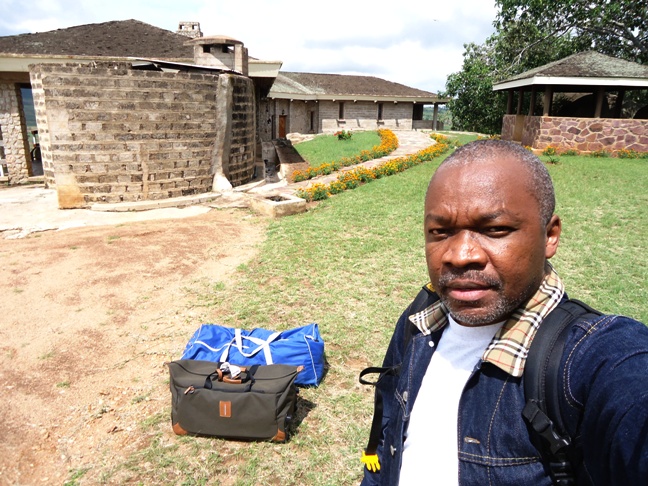
This morning I packed my climbing gear and some clothes in two bags and waited for the bodaboda (motorcycle taxi) to take me to the Musoma - Mwanza road for a bus trip to Mwanza and an onward connection to Moshi. It is amazing to see how much can be loaded on a motorcycle.
Post related to this one:
Subscribe to:
Posts (Atom)